
“Chinese machines are cheap... but are they secretly costing your business money every day?”
In the era of Industry 4.0, machine vision systems are no longer a strange technology. Many factories are applying it to check quality, automate production and reduce human dependence. However, a common reality is that businesses are often attracted to cheap vision systems, especially from China. This seems like a wise financial decision — but in reality, it can be a "trap" that makes businesses silently lose money every day without knowing it.
Cheap hardware does not mean high efficiency
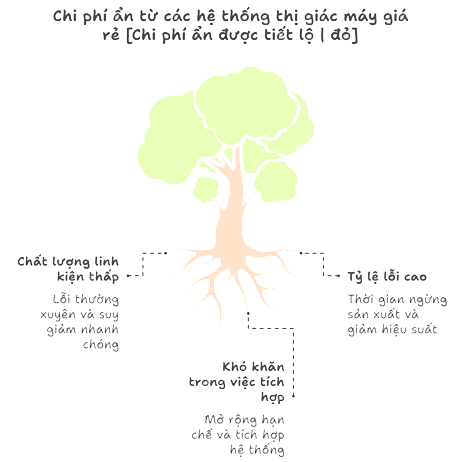
Many low-cost vision systems offered by Chinese manufacturers, while attractive in initial cost, have problems that are not immediately apparent, such as:
1. Low quality components, prone to failure
- Cameras, lights, lenses are not strictly inspected → Easily damaged, degraded quickly.
- Components are not designed to industrial-grade standards, not “ruggedized” for harsh environments.
- Sources of noise, vibration, dust or high temperature → Causes continuous errors or hardware damage.
Real-world example: A factory using low-cost cameras for its food packaging line lost up to 8 hours/week to troubleshoot errors caused by inaccurate measuring equipment due to small vibrations of the conveyor belt.
Time and labor costs add up silently
2. High error rate and downtime
- Cheap equipment often does not have the ability to automatically calibrate or adapt → The system often needs to be reset and calibrated manually.
- Runs stably in the early stages, but after a few months → recognition speed decreases, images become blurry, OCR/OCV fails.
- Requires human resources to intervene → Disrupts production, reduces productivity.
A vision system that fails twice a week, each time for only 20 minutes, will cost you more than 35 hours of production per year – equivalent to hundreds of millions of dollars in opportunity cost if calculated based on factory productivity.
Cheap solutions often lack scalability and integration
3. Difficult to integrate with modern automated manufacturing systems
- Unfriendly software interface, lack of support for standard protocols such as OPC-UA, Modbus, EtherCAT.
- Cannot easily connect to modern MES, ERP, or PLC systems.
- AI/Deep Learning processing capability is almost zero or requires "manual configuration" which is very time-consuming.
A difficult-to-integrate system costs businesses high technical personnel costs, and takes a lot of time for each new line expansion.
Investing in machine vision right – is investing in future production efficiency and data
Solution from AVATECH: Smart, durable, reliable industrial vision system
We propose an “AVATECH” model approach – not just good hardware, but an ecosystem that optimizes total cost of ownership (TCO):
A – Advanced Vision
- Smart/3D camera with integrated AI, industrial design.
- RGB, IR, Polarized synchronized lighting for each product type.
- Autofocus lens, anti-shake, dust, high temperature.
→ Benefits:
- Clear, stable images over many years of operation.
- Low maintenance, reduced downtime.
- Intuitive interface
- Supports Deep Learning models such as surface defects, image classification, and fuzzy character recognition.
- Early warning according to SPC statistical deviation threshold.
→ Benefits:
- Rapid AI training with just a few dozen image samples.
- Current staff can learn and operate after 1 week.
T – Total Insight & Traceability
- Automatically record error images, inspection results.
- Integrate API with MES, SAP, cloud server systems.
→ Benefits:
- Traceability of all production data.
- Provide data-based quality improvements.
Summary:

You want to save – but save wisely
If you are considering between “cheap price” and “sustainable investment”, let AVATECH team accompany you from survey, testing, to implementation and optimization.
Contact us for a free consultation and receive a detailed TCO analysis for your plant.