
Are you checking the quality or just 'looking for appearances'?
In the modern manufacturing era, where quality is synonymous with brand reputation and business survival, the question: "Are you testing for quality or are you just 'looking for it'?" is not only a reminder, but also a wake-up call.
It is time for manufacturers, quality engineers and automation experts to take a look - is your product inspection system really delivering value, or is it just a facade?
I. What is quality inspection really?
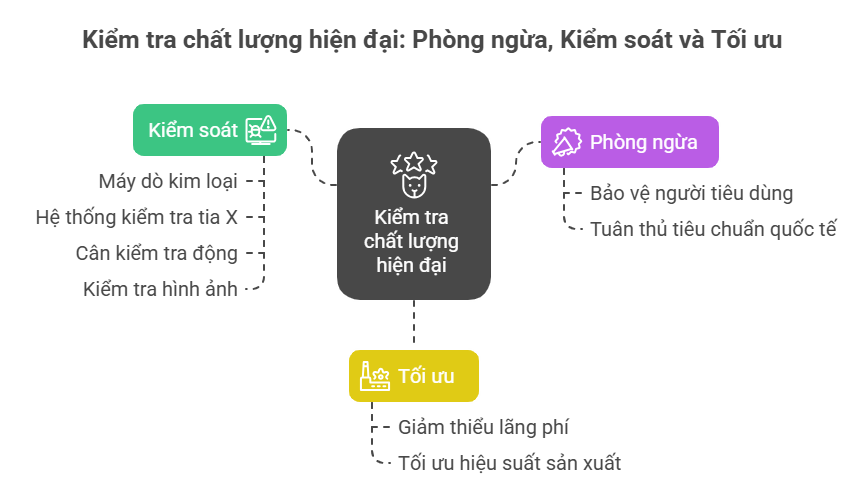
1. More than "detection" - it is prevention, control and optimization
A modern quality inspection system is not only responsible for "catching errors" but also acts as a proactive monitoring tool, helping to:
- Protect consumers and brands: Detect foreign objects such as metal, calcified bone, glass, high-density plastic.
- Strictly comply with international standards such as HACCP, BRC, IFS, SQF, FSSC 22000 or FDA 21 CFR Part 11.
- Minimize waste by early detection of defective products such as underweight, damaged packaging.
- Optimize production efficiency (OEE): Increase uptime, reduce downtime, quick product changeover.
2. Core technologies
- Metal detector (Mettler Toledo M33R, M34R): Detect metal in dry or wet products thanks to MSF technology and automatic calibration.
- X-ray inspection system (Sesotec RAYCON D+): Accurately detect impurities from 0.3mm stainless steel, even with metalized packaging.
- Dynamic checkweigher: Detect abnormal trends and help adjust the dosage immediately.
- Image inspection (Machine Vision): Color analysis, defects, barcodes, OCR, coating uniformity – from industrial products to food.
II. Signs you are “just looking”
A visual inspection system often has the following weaknesses:
- Failure to detect rare errors, lack of sensitivity to difficult products such as wet goods or products with “product effects”.
- Recorded data is fuzzy, no traceability.
- Inappropriate optical system: lenses do not achieve MTF > 20%, low DOF, suboptimal lighting.
- Running old algorithms or deep learning models trained on incomplete data.
- No regular performance testing schedule, or improper use of test samples.
- Inadequate training of staff, not understanding how to optimize the system.
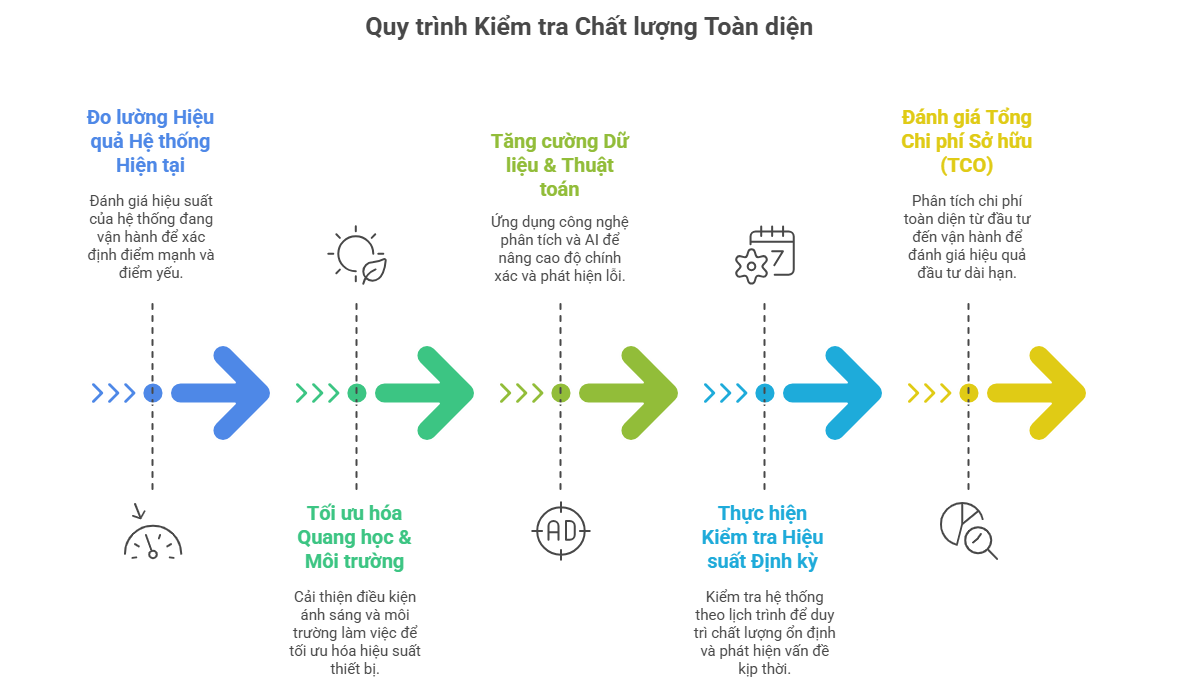
III. How to truly “check quality”?
1. Re-measure the effectiveness of the current system
- Detection sensitivity: Can the system detect impurities < 0.5mm? Does it operate stably with many types of products?
- Error elimination mechanism: Does it confirm successful rejection?
- Integrated monitoring software: aVisPro (AVATECH), ProdX (Mettler Toledo), Insight.NET (Sesotec) to help manage data in real time and ensure traceability.
- Storage & reporting: Are there full operation logs, X-ray images, warnings when deviations occur?
2. Optimal optics & environment
- Suitable lens: Select based on sensor pixel size, resolution and MTF.
- Precise illumination: Use monochromatic light, directional light, washdown lights for harsh environments.
- Understand DOF & lighting conditions: Especially important for non-flat surfaces and reflective products.
3. Enhance data & algorithms
- Train deep learning models on rare defect data.
- Use modern software such as aVisPro (AVATECH), Cognex ViDi, SuaKIT, OPT Smart3, Sapera for segmentation, pattern recognition, defect detection.
- Apply advanced technology such as:
- Hyperspectral imaging
- Time-of-Flight (ToF)
- Photometric Stereo for 3D surfaces
4. Periodic performance testing
- Perform testing with standard samples every shift, or when changing products.
- Independently verify the system at least annually.
- Take advantage of automatic calibration features if available.
- Warning when performance testing is out of date.
5. Evaluate Total Cost of Ownership (TCO)
- Compare not only purchase price but also operating costs, downtime, maintenance.
- Choose a vendor with strong technical support, training, and a pre-investment testing program.
Conclusion
Quality inspection systems – whether checkweighing, metal detection, X-rays or machine vision – are only truly valuable when they provide accurate data, timely action and insight to improve processes.
If your system simply “runs” without delivering specific measurements, you may be “looking the other way” rather than truly inspecting quality.
It’s time to ask yourself:
Is my system preventing defects – or is it just detecting them after it’s too late?
Do I have clear data to demonstrate the effectiveness of my current system?
What can I improve today to avoid losses tomorrow?